Footings · crane outriggers · piers
Bearing Capacity Assessments
Proof that the ground will carry the load — from a house slab to a 200 tonne crane — measured in the excavation rather than assumed from a table.
What it confirms
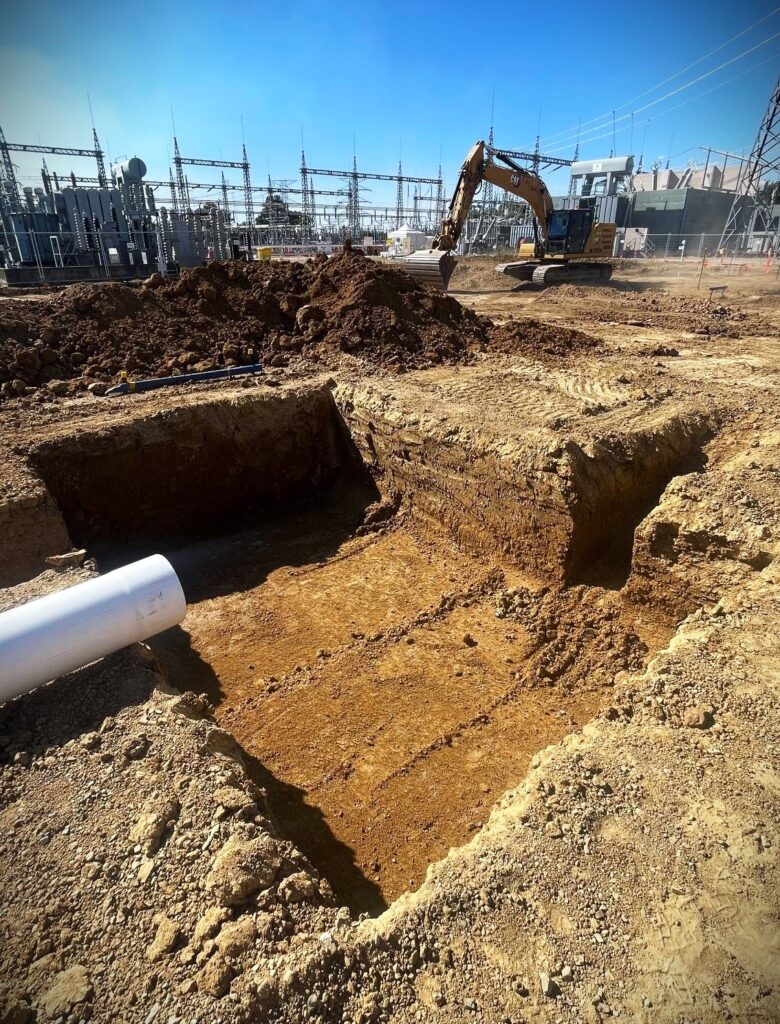
A bearing capacity assessment confirms the soil foundation can support the proposed loading, whether that is low — a residential dwelling — or high, like a 200 tonne crane or a piling rig. Ultimate and allowable bearing capacity is a complex piece of soil mechanics: particle size distribution, cohesion, density, moisture content and the depth of the underlying soils all change the answer.
That is why the number comes from a qualified geotechnical engineer rather than a chart. We test the ground that will actually carry the load, then interpret it.
Where we test
Usually during construction, in the excavation, before anything is poured or tracked onto it.
- Base of pad and strip footing excavations
- Base of pier footings, tested through casing
- Crane outrigger locations, before the lift
- Sheds, extensions and residential footings
Plate load testing
Sand and gravel blends are best assessed by loading a plate against site machinery and measuring settlement over 40 minutes.
Dynamic cone penetrometer
Silts and clays are best assessed with a DCP, driven in the base of the excavation to a maximum test depth of 3.0m.
Common questions
What does an assessment cost?
It depends on the number of test locations, the method the soil calls for and travel to site. Several footings assessed in one visit cost far less per location than separate call-outs. Send the site address and how many points you need and we will price it the same day.
When in the build should it happen?
Once the excavation is open and before steel or concrete goes in. For crane work, before the machine is set up. We can usually attend at short notice because the rigs and engineers are ours.
What happens if the ground does not make the number?
Our engineers give you options rather than a fail: deepen the footing, widen it, improve or replace the material, or redesign to a lower allowable pressure. The aim is to keep you building.
How is this different from a site classification?
A site classification is done before design and classifies the whole lot for an AS 2870 footing system. A bearing capacity assessment is done during construction and confirms a specific excavation at a specific depth will carry a specific load.
Proven on site
Where we have assessed the ground
All projects
Discuss your project
Speak to one of our geotechnical engineers — no call centre, no sales script.
Contact details