AS 1012 · NATA accredited
Concrete Testing
Compressive strength, slump, flexural strength, shrinkage and air content — tested to the Australian Standards in our own laboratories at Wagga Wagga, Griffith and Albury/Wodonga.
More than a 28-day number
Modern concrete is a specialised mix of sand, gravel, cement and additives. Engineers specify a mix to reach a minimum compressive strength at 28 days, but the design also accounts for site location and climate, flexural strength, air voids and slump. The strength test is the obvious one; the others are what confirm the supplied concrete actually suits its intended use.
The tests we run
Each one is NATA-accredited to its Australian Standard.
Compressive strength
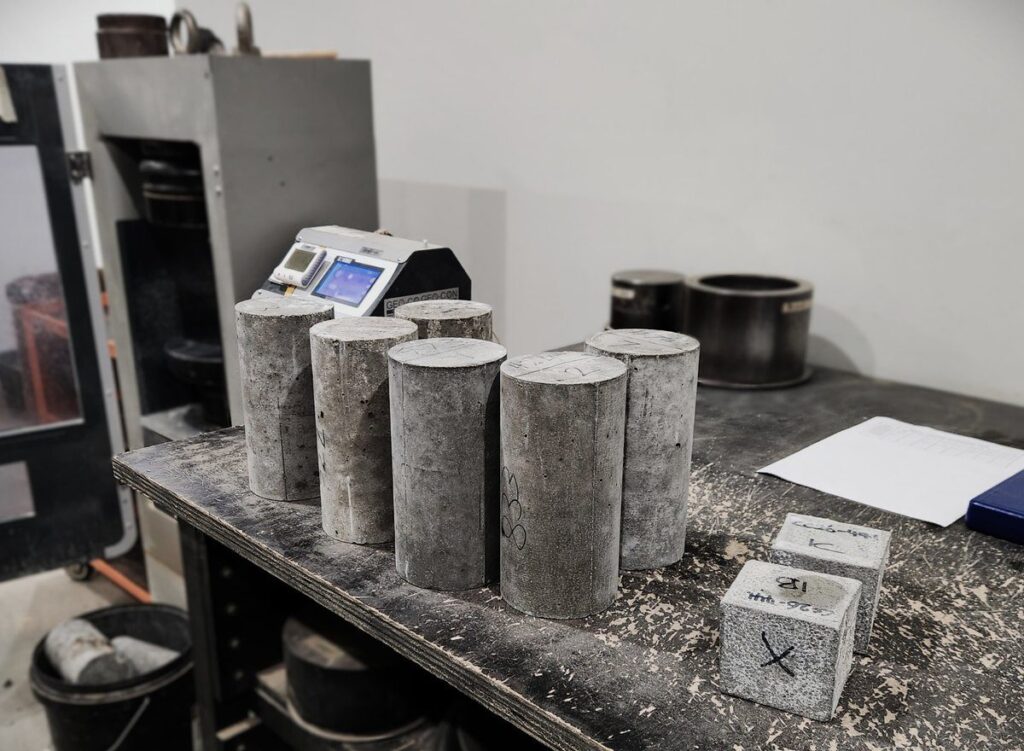
Fresh concrete is compacted into 200mm x 100mm moulds, then cured in a temperature-controlled water bath. At the specified age the ends are capped and the cylinder is loaded at a set pace rate until it fractures. The failure load divided by the surface area gives the result in MPa — so 32MPa concrete must reach 32MPa at 28 days. This is run on most commercial and residential projects.
The same test applies to grout, cast as cubes rather than cylinders — we can supply moulds for self-sampling or attend site ourselves.
Schmidt rebound hammer
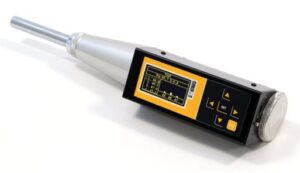
When cylinders were not taken during the pour, strength can still be estimated without destroying anything. A spring-loaded mass of known energy is driven into the surface and rebounds; the rebound is recorded and converted to an estimated compressive strength.
We use a digital rebound hammer horizontally or vertically. To confirm the strength of an existing slab or large footing we test in a grid across it, then take a minimum of three cores and correlate the results — which is far more reliable than the hammer alone.
Slump
Workability matters as much as strength. A wet, high-flowing mix suits pumping to height or a self-levelling pour; a low-workability mix suits mass structures like dams, where too much moisture generates heat that can damage the structure.
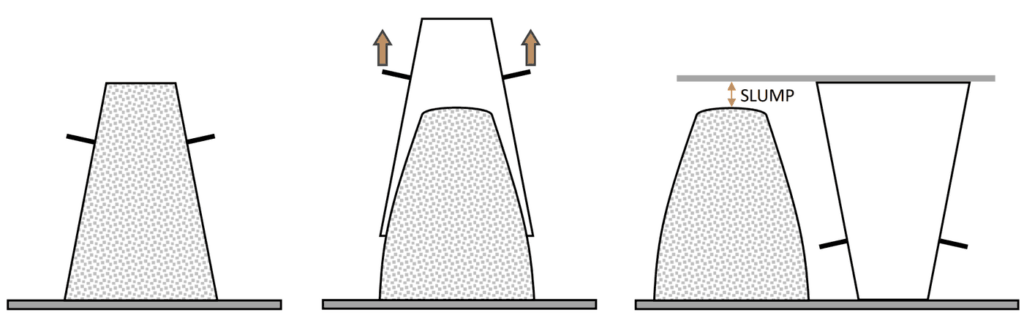
The cone is filled with compacted concrete in three layers, levelled, then lifted clear and set upside down beside the slumped concrete. The difference in height is the slump.
Flexural strength
Also called indirect tensile strength. A beam cast in a rectangular mould is loaded in a roller frame — two bottom supports, two upper rollers pressing down — until it breaks. Typically specified on commercial-scale projects.
Drying shrinkage
There are two certainties with concrete: it will get hard, and it will crack. Cracking is managed with mix additives, strict moisture control and properly positioned control joints — pre-planned cracks. Shrinkage testing confirms the mix stays within the limits the designer specified.
A specimen is cast in a rectangular mould with stainless steel studs set in place, demoulded once hardened, then monitored for length change in a controlled environment. Monitoring can run up to three months, though most specifications call for 21 and 56 day results.
Air content
Mixes for certain climates need tight control of air voids: too little and freeze-thaw resistance drops, too much cuts compressive strength considerably.
Fresh concrete is compacted into a sealed bowl with an upper air chamber attached. Surrounding air is replaced with water and fine-tuned with valves, then a hand pump pressurises the upper chamber and releases it into the concrete below — the gauge reads the apparent air content. We run it alongside the routine tests on the same visit.
Common questions
How much does concrete testing cost?
Concrete testing is charged per site visit plus per specimen tested, so the cost depends on how many pours you need covered and how many cylinders come from each. Projects with regular pours are put on a project rate. Send us the pour schedule and what is specified and we will price it properly.
When do we get the results?
Slump and air content are measured on site during the pour. Compressive strength is reported at the specified age — 28 days for nominal strength, with 7-day early breaks available when you need an indication before then.
Nobody took cylinders during the pour — can the slab still be tested?
Yes. We test the hardened concrete with a digital rebound hammer in a grid across the slab, then core a minimum of three samples and correlate the two. That gives a defensible strength estimate rather than a hammer reading alone.
Can you supply moulds, or do you come to site?
Either. For grout cubes we can supply moulds for self-sampling, or our geotechnician attends and samples themselves — usually alongside slump, air content and the rest of the field testing.
Proven on site
Concrete testing projects
All projects
Discuss your project
Speak to one of our geotechnical engineers — no call centre, no sales script.
Contact details